Visual arts & new media

Work of the Week: Strange Jury #2 by Dwayne Martineau

Sticky at top of newsfeed
No
Article teaser

Work of the Week invites you to explore the unnoticed world of nature and to challenge our perspectives.

Body

Strange Jury #2 asks the viewer to challenge their perspectives by seeing nature through a different lens. The artwork is intended to depict a trial in the forest. The viewer is the defendant. The jury is Nature.

This artwork is part of a series of five works. When installed in a gallery, five giant prints are hung in a circle off the ground to depict five characters of the forest with animistic faces. The AFA acquired one of these prints through the Art Acquisitions by Application to be a part of the AFA Art Collection.
 

About the artist

Dwayne Martineau is an Edmonton based visual artist and musician. He is a treaty member of Frog Lake First Nation, descended from Plains Cree, Métis, and early French and Scottish settlers.

He enjoys seeing the world like a child full of discovery. Also, he approaches the world with a critical mind, seeking both truth and wonder. His visual arts practice began with experimental landscape photography, and has evolved to include videography and immersive large-scale art installations.

Art Acquisitions by Application

The next deadline for the AFA’s Art Acquisition by Application program is April 1! Read the guidelines if you’re interested in submitting your artwork to have it be considered for acquisition to the AFA Art Collection.

Image description

The artwork is an abstracted photograph on backlit film that suggests an animistic creature in a forest. A black, insect-like face with large antennae floats on a faded yellow background, with black trees and bushes in the background. 

Facebook title
Work of the Week: Strange Jury #2 by Dwayne Martineau
Twitter title
Work of the Week: Strange Jury #2-Dwayne Martineau
Button text
Apply
Social Media Preview
Collections Database Image
Image
Artist
Dwayne Martineau
Title
Strange Jury
Year
2021
Medium
Photograph on backlit film
Collections Images Slideshow

Work of the Week celebrates Family Day

Sticky at top of newsfeed
No
Article teaser

On Family Day, February 21, 2022, celebrate time with your family and loved ones.

Body

Family Day is an opportunity to appreciate what makes family special and to spend quality time with your family and loved ones. Having positive personal connections can help with overall health and well-being.

Every family make up is different. The definition of family can be much broader than the traditional picture of a mother, father and their children. Our featured work, Family of Three by Stanford Perrot, takes this traditional concept of family and abstracts the image to express feeling through shape, line and color.
 

Let us recognize and honour the many different types of family units there can be: the best building blocks to happiness are healthy relationships.

Enjoy Family Day and we encourage you to take part in art and explore the province with your loved ones:

  • AFA's virtual museum: check out our online collection of Albertans' artwork from the comfort of your home
  • Alberta license free Family Fishing Weekend: see if there is an opportunity to photograph the moments or sketch your experience afterwards 
  • Alberta historic sites and museums: selected museums and sites are offering free admission. Contact each heritage facility first prior to attending to check on the opening hours, advanced registration and COVID guidelines. See if there are any artwork there that sparks your inner creativity.

About the artist

Stanford Perrott was an influential art educator and watercolourist. His collection also includes mid-century abstract work.

He was born in Claresholm, Alberta and studied in New York. He also attended and taught at the Provincial Institute of Technology and Art, where he eventually became the head of the college. He learnt from Hans Hoffman and was strongly influenced by abstract expressionism and cubism.

In the 1960s, Perrott convinced the government of Alberta to expand the arts section of the institute to have its own building. Perrott and his associates made his wish come true in creating the Alberta College of Art and Design (which has since further transformed into the Alberta University of the Arts). 

Although he did not raise a family of his own, he was an excellent educator and mentor to his students and colleagues – his extended family.

Image description

The image is an abstracted form of a family of three, represented by simple curvilinear forms. The adult and child figures are depicted through black and white shapes, accented with red and green tones. The artwork is lithograph on paper.

Facebook title
Work of the Week celebrates Family Day
Facebook description

On Family Day, February 21, 2022, celebrate time with your family and loved ones.

Twitter title
Work of the Week celebrates Family Day
Twitter description

On Family Day, February 21, 2022, celebrate time with your family and loved ones.

Button text
AFA's virtual museum
News type
Art discipline
Social Media Preview
Collections Database Image
Image
Artist
Stanford Perrott
Title
Family of Three
Year
1954
Medium
Lithograph on paper
Collections Images Slideshow

Work of the Week celebrates Lunar New Year

Sticky at top of newsfeed
No
Article teaser

This week's Work of the Week is "Fortune Cookie" by Peter Greendale

Body

Did you know Lunar New Year is celebrated by various cultures including Chinese, Korean, Vietnamese, and other East and Southeast Asian cultures? Every year, the date changes depending on the first new moon to mark the new year. 
 

While each culture and ethnicity celebrates with differing foods, duration and traditions, each culture shares the same goal of reunion and well wishes of prosperity for the coming year. We hope the Year of the Tiger brings you a year full of good health, success and happiness!
 

About the artist:

Peter Greendale started his residency at the Banff Centre in 1984/85. He is inspired by the common everyday object and the culture's origin.

Facebook title
Work of the Week celebrates Lunar New Year
Facebook description

This week's Work of the Week is "Fortune Cookie" by Peter Greendale

Twitter title
Work of the Week celebrates Lunar New Year
Twitter description

This week's Work of the Week is "Fortune Cookie" by Peter Greendale

Button text
AFA's virtual museum
Art discipline
Social Media Preview
Collections Database Image
Image
Artist
Peter Greendale
Title
Fortune Cookie
Year
1994
Medium
charcoal on paper
Collections Images Slideshow
Peter Greendale
Fortune Cookie
1994
charcoal

Work of the Week: "Elephants Chiefly Series" by Illingworth Kerr

Sticky at top of newsfeed
No
Article teaser

This week's Work of the Week is "Elephants Chiefly Series" by Illingworth Kerr!

Body

This week's Work of the Week is Elephants Chiefly Series by Illingworth Kerr in honour of World Elephant Day, which was on Wednesday, August 12.
 

This conte crayon sketch of of an elephant is just one of 21 sketches of elephants by Kerr in the AFA's collection! You can see all the elephants sketches here.

Did you know: Elephants and humans share a long history throughout our civilization? The Asian elephant has lived alongside humans for over 4,000 years and is imbued with reverence, tradition and spirituality across many cultures. 
 

About the Artist: Illingworth Kerr (1905-1989)

llingworth Kerr studied at the Central Technical School, Toronto in 1924. From 1924 to 1927, Kerr studied under Arthur Lismer, J.E.H. MacDonald, Frederick Varley and J.W. Beatty at the Ontario College of Arts. Kerr also studied at the Westminster School of Art, London, in 1936, as well as with Hans Hoffman in Provincetown, Massachusetts in 1954. In 1955 and 1957, he attended Emma Lake Workshops.

He taught at the Vancouver School of Art from 1945 to 1946 and was head of the Alberta College of Art (now the Alberta University of the Arts) from 1947 to 1967. There he was a great influence and friend to many artists of that era. From 1952 to 1953, he was president of the Alberta Society of Artists. Kerr was also a member of the Canadian Authors Association; he wrote many short stories and illustrated many publications, including his autobiography, Gay Dogs and Dark Horses, in 1946. He received a Canada Council Award in 1960.

He painted portraits, the life of Indigenous peoples, urban views, wildlife, and the prairie and Ontario landscape. He used the media of oil, acrylic, watercolour, charcoal, and ink, as well as woodblock, linoblock, monotype and silkscreen prints.


Facebook title
Work of the Week
Twitter title
Work of the Week
News type
Art discipline
Collections Database Image
Image
Artist
Illingworth Kerr
Title
ELEPHANTS CHIEFLY SERIES
Year
n.d.
Medium
conte crayon
Collections Images Slideshow
Expiry

Work of the Week: "Good Dog" by Lori Lukasewich

Sticky at top of newsfeed
No
Article teaser

This week's Work of the Week is "Good Dog" by Lori Lukasewich.

Body

We can't let this week end without celebrating National Dog Day, which was on August 26, so this week's Work of the Week is Good Dog by Lori Lukasewich!
 

About the Artist: Lori Lukasewich
 

Lori Lukasewich has been painting and exhibiting since 1984. She often paints intimate scenes with domestic objects, like a porcelain figure or a silver tea set. In this age of immediacy and urgency, her work slows things down and contemplates stillness and focus, and reflects on perceptions of value, particularly on domesticity and the woman’s role in creating a home. She shines a light on the beauty of everyday home life as a common and necessary antidote to the difficulties and stress of the modern-day world.

Lukasewich paints in oils and alkyd mediums, using modified traditional techniques of underpainting, overpainting and glazing. While clearly influenced by realism and the painting techniques of the Old Masters, her work owes more of a debt to the practice of meditation. Her realist paintings often express an ethereal light and singular focus that is at once calming and pleasurable.

Lukasewich studied art at the Alberta College of Art and Design (now the Alberta University of the Arts), and has applied her skills to painting, graphic arts, jewelry design, palaeontological restoration, and film and television. She has also written and illustrated three children’s books.

Lukasewich has been teaching painting for 20 years, much of that time in the Extended Studios program at the Alberta University of the Arts (AUArts). She has exhibited extensively, and her work can be found in many public and private collections.

Facebook title
Work of the Week
Twitter title
Work of the Week
Button text
AFA Virtual Museum
News type
Art discipline
Social Media Preview
Collections Database Image
Image
Artist
Lori Lukasewich
Title
Good Dog
Year
2010
Medium
oil, alkyd
Collections Images Slideshow
Expiry

Work of the Week: "Cold Night at the Yards" by Stan Phelps

Sticky at top of newsfeed
No
Article teaser

This week's Work of the Week is "Cold Night at the Yards" by Stan Phelps.

Body

This week's Work of the Week is Cold Night at the Yards by Stan Phelps. 
 

Brrr! It's cold out there! A polar vortex has settled over much of the prairies bringing icy cold temperatures for the next few days. 
 

This artwork by Stan Phelps really captures the feeling of a cold, dark night with the exhaust from industrial buildings hanging in the frigid air. 

About the Artist: Stan Phelps

Stan Phelps is a Calgary-based artist and teacher, known for his prints, paintings and murals.

He earned a BFA from the University of Calgary in 1974. After graduation, he worked as a graphic artist and freelance writer and photographer, as well as teaching art, for the City of Calgary. He also taught for the Calgary and the Catholic School Boards. After five years with the City, he travelled widely in Europe, mostly to Spain. There he lived for a year, sketching, painting and visiting art galleries. He was a visiting artist at several international studios, including in Murcia, Spain and Urapan, Mexico. His artwork is often inspired by his travels.

In 1978, Phelps and his partner, artist Carole Bondaroff, founded The Heart Studio in Calgary’s Kensington area. This multi-disciplinary art facility holds exhibitions, and offers classes and workshops for adults and children. Phelps’ teaching work extends to positions such as Artist in Residence in various Alberta schools, where he introduces students to making art including murals, cartoons and inflatable sculptures. He has also served as Director and Artist in Residence at the Perrenoud Homestead Historic Site and Art Centre, near Cochrane, Alberta.

Phelps’ art works comprise oils, acrylics and watercolours, mostly of landscapes, historic buildings and figures in urban settings. He has also produced etchings, such as the Muses series (2010), lighthearted depictions of the Greek goddesses of culture. His murals can be seen throughout Western Canada, especially in Southern Alberta, and feature scenes from local history. They are also on display at the Calgary Stampede, the Calgary Public Library and at Calgary’s International Airport.

His works have been purchased by the Canada Council Art Bank in Ottawa, and are held in private and corporate collections nationally and internationally.
 

Facebook title
Work of the Week
Twitter title
Work of the Week
Button text
AFA Virtual Museum
News type
Art discipline
Social Media Preview
Collections Database Image
Image
Artist
Stan Phelps
Title
COLD NIGHT AT THE YARDS
Year
1987
Medium
COLOUR ETCHING ON PAPER
Collections Images Slideshow
Expiry

Work of the Week: "Wisdom Trail" by Alex Janvier

Sticky at top of newsfeed
No
Article teaser

This week’s Work of the Week is "Wisdom Trail" by acclaimed Indigenous artist Alex Janvier.

Body

This week’s Work of the Week is Wisdom Trail by acclaimed Indigenous artist Alex Janvier in honour of the master artist’s birthday, which was this past Sunday on February 28!

Happy to birthday to Mr. Janvier!
 

About the Artist: Alex Janvier

Alex Janvier was born on the Le Goff Reserve, Cold Lake First Nations, Alberta, in 1935.

He was raised in the Chipewyan tradition until he attended the Blue Quill Residential Indian School at the age of eight. Janvier graduated with Honours from the Alberta College of Art in 1960 and since then has built an international reputation as a painter, muralist and printmaker. He has influenced a younger generation of native artists through his paintings and advocacy work with arts organizations and land claim committees.

Janvier's imagery is a combination of traditional native decorative motifs such as medicine wheels, floral designs and symbolic colour combinations. In the late 1980's and early 1990's, his work became more representational and concerned with specific social and political issues.

Janvier has been the recipient of many accolades throughout his career. Since 2007, he has received honourary doctorates from both the University of Calgary and the University of Alberta, was appointed to the Order of Canada, received a Governor General's Award in Visual and Media Arts and was the first ever recipient of the Marion Nicoll Visual Arts Award from the Alberta Foundation for the Arts.

Alex Janvier continues to live and work in Cold Lake.

Facebook title
Work of the Week
Twitter title
Work of the Week
Button text
AFA Virtual Museum
News type
Collections Database Image
Image
Artist
Alex Janvier
Title
WISDOM TRAIL
Year
n.d.
Medium
acrylic on burlap
Collections Images Slideshow
Expiry

Double Take: An Emerging Curator Exhibition

Sticky at top of newsfeed
No
Article teaser

Double Take, curated by Shannon Bingeman, challenges perceptions of logical order.

Body

Double Take is curated by Shannon Bingeman, and generously funded through the Alberta Foundation for the Arts Emerging Curator Fellowship. Click through the images in the exhibition above, then scroll down to learn more about the pieces.
 

Explore this exhibition on Google Arts & Culture.

Double Take challenges perceptions of logical order. Each piece represented in the show has elements that are inherently familiar—a bed, a human figure, doorways, houses, vases—and yet, they provoke a feeling of the uncanny. There is something mysterious, alluring and in some instances, eerie, about each sculpture, photograph and installation.

The uncanny is a psychoanalytic concept that dates back to the writings of Ernst Jentsch in 1906. Although the term is difficult to define because it relies on personal experience, it is generally agreed that something that possesses uncanny characteristics combines elements of the familiar and the peculiar—a tension between the known and the unknown. Over the years, many artists have fabricated uncanny elements in their work as a method of questioning reality and exploring displacement and illusion.

In Greg Payce’s work the uncanny is achieved through manipulation of space. At first glance his ceramics read as a traditional arrangement of decorative objects but it doesn’t take long before illusions of bodies, faces and shoes emerge in the negative spaces. Kristopher Karklin and Colin Smith are artists who also explore illusion to create dynamic images. Karklin presents us with a seemingly ordinary photograph of a woman standing in a nondescript space but something is slightly askew. What we are actually looking at is a photograph of a miniature room modeled by the artist. The figure was photographed separately and superimposed to create the final image. For Smith, illusion is explored using a camera obscura, an optical device that predates photography. Images of exterior scenes pass through a small lens into a darkened room and are inverted and projected onto the walls. The result is an alluring juxtaposition between two seemingly disparate worlds that leaves the viewer ungrounded—what is up and what is down?

Michael Campbell, Sarah Fuller and Dan Hudson challenge perceptions of logical order through their interventions into nature. Campbell achieves this by including unexpected objects in the environment-- things that we would expect to find at an airport rather than in the interior of a forest. In Fuller’s work it is the opposite. The photographic prints on linen in Aldcroft Residence and Dubois Residence, which illustrate houses nestled into the woods, seem eerily fitting in their environment. Nevertheless, the viewer is aware that what they are looking at is an illusion. In Dan Hudson’s installation, River, it is the manipulation of time in the recorded landscape that lends itself to notions of the uncanny. We witness the season’s change at a rapid pace but the meticulous editing makes it feel as though the video was filmed in real time.

According to Caterina Albano in her article Uncanny: A Dimension in Contemporary Art “the uncanny happens as a blurring of reality at the erosion of the boundaries between the real and the imagined.”[1] All of the artists included in this exhibition explore that boundary through their use of scale, materials, optical effects and spatial manipulations. The result is a compelling arrangement of artwork that stimulates cognitive tension and warrants further investigation.


Artwork Descriptions

Kristopher Karklin, Jack and Jill Room, 2011, digital print on paper, 2012.018.001

Process and memory are fundamental to Karklin’s work. Jack and Jill Room is not a documented record of a specific place and time but a composite image skillfully crafted. The artist begins his process by re-creating environments from his memory in the form of miniature models. Like memory, these built environments are subject to distortion. The model and the figure are photographed separately and superimposed to complete the narrative. The lack of detail in the room and the anonymity of the figure are intentional. It removes ownership of the artist’s memory and allows us to recall our own lived experiences.


Sarah Fuller, Aldcroft Residence, 2013, archival inkjet print on ilford galerie gold fibre silk, 2014.016.001

Sarah Fuller, Dubois Residence, 2013, archival inkjet print on ilford galerie gold fibre silk, 2014.016.002

The buildings in Aldcroft Residence and Dubois Residence are both at home and displaced. The photographs are a record of a site-specific installation that the artist created in Bear Creek, Yukon Territory in 2013. Originally constructed as a company town for the Yukon Consolidated Gold Corporation, Bear Creek was abandoned in 1966 and many of the buildings were lifted from their foundations and transported to nearby Dawson City. Titled The Homecoming, Fuller’s installation integrated five of these buildings back into their original location using large-scale prints on linen. She also used theatre techniques from the 19th century to manipulate the prints, making them appear to transition from dusk to night. The end result is a ghost-like conjuring of the past—one that reminds us of the transient nature of place.


Colin Smith, Sebee, AB, 2010, archival metallic lightjet print on plexiglass, 2010.042.004

Colin Smith, Vulcan Aerodome, 2010, archival metallic lightjet print on plexiglass, 2010.042.005

Colin Smith, 56 Trolley, 2010, archival metallic lightjet print on plexiglass, 2010.042.001

Light passes through a small hole in a darkened room and the space is transformed. An inverted image of the exterior world is cast over the interior walls and the effect is photographed by the artist using a single exposure that can take hours. The process appears complex but the physics behind it is quite simple. Smith creates his work using a camera obscura, an optical device that dates back to antiquity and has been used as a tool by artists including Johannes Vermeer (1632-1675). Like the camera obscura, the scenes that Smith captures have a rich connection to the past. Sebee, Vulcan Aerodome and 56 Trolley are all records of abandoned Albertan landscapes included in the Camera Obscura in Abandoned Landscape Series.


Colin Smith, Satellite Motel, 2009, archival metallic lightjet print, 2012.027.001

Colin Smith’s journey into photography began during a motorcycle trip from Calgary to Santiago in 1997. The influence of the road is apparent in Satellite Motel: one photograph in the Rooms With a View Series that was taken in hotel rooms across Western Canada. For anyone who has travelled through Medicine Hat on the trans Canada highway, the sign in Satellite Motel may look familiar. It is one of a handful of old motel signs that still remain on the outskirts of the city. Typical to Smith’s style, the image is constructed using a camera obscura. 


Greg Payce, Vase to Vase, 1995, earthenware with terra sigillata, 2011.058.004.A-C

Greg Payce, Pairadocs, 1996, earthenware with terra sigillata, 2011.058-006.A-C

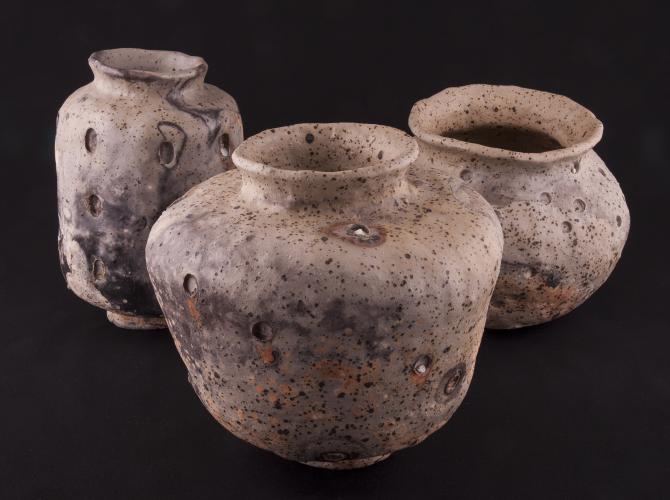
Greg Payce’s work is an exploration of binary relationships—shape and form, background and foreground, reality and illusion. In Pairadocs and Vase to Vase the result of this exploration creates compelling optical illusions that formalize in the negative spaces between the vases. These vases are arranged in a manner reminiscent of a garniture (a traditional arrangement of two to five vases on a mantelpiece) and yet their skillfully articulated profiles reveal unexpected subjects – a pair of Doc Marten shoes and two faces. Furthermore, the artist adds a layer of humour to each work through the clever wordplay in his titles; Pairadocs rather than paradox and Vase to Vase recalling the term face to face.


Greg Payce, Kiss Detail, 2001, digital photograph on vinyl, 2011.058.009

Kiss Detail documents a portion of the artist’s three-dimensional work through the use of photography. Unlike Pairadocs and Vase to Vase, the whole of the ceramic work is not visible and the shape created by the negative space is quite ambiguous. Instead the figurative component in this work is connected to the vessel itself. The modulation of the edge on each piece reveals a generic depiction of two figures, one male and one female ready for an embrace.


Greg Payce, David, 2006, porcelain, 2007.023.001.AB

Greg Payce, Gemini, 2006, porcelain, 2007.023.002.ABC

In David and Gemini the illusionary figures are strikingly similar and nondescript. They appear as idealized depictions of the male figure but not specific to any male in particular. This effect allows the work to be open to interpretation. The artist isn’t trying to convey a specific meaning, but his titles are suggestive of biblical and astrological subjects. David may be a reference to the hero who slayed Goliath and whose idealized figure has been immortalized in stone by many artists including Donatello, Bernini and perhaps most famously, Michelangelo. Also, Gemini with its two identical figures, is likely a reference to the constellation of the same name, which fittingly means twins in Latin.


Greg Payce, Pantheon Verismilus, 2007, digital image laminated with plastic lenticular lens on laminate Dibond, 2011.058.010.A-E

In this work, Payce alters our experience of ceramic objects by moving away from an emphasis on the handmade, tactile quality of the medium towards a fascinating optical effect using lenticular photography; a technology that gives printed images the illusion of depth. Pantheon Verismilus, which depicts 40 vessels with implied male and female forms, is the artist’s first large scale image using this method. When viewed in person, it has a holographic-like appearance, an effect that is created by interlacing multiple images of an object from different vantage points. After the image is printed, plastic lenses are laminated to the surface and reflect portions of the image depending on the viewer’s perspective. As the viewer shifts in relation to the photograph, the image is in flux, appearing three-dimensional. By using this technology, the artist is able to work on a monumental scale in a way that would not be practical in ceramics. The vessels take on an almost human scale, which in the words of the artist “heighten the physical and visceral relationship to the viewer’s own body scale.”[2]


Michael Campbell, Remote Transponder I (Granite Staircase), 2003, backlit digital photograph printed on transparent film, painted wood box, fluorescent light bulb, 2004.003.001

Michael Campbell’s installation Remote Transponder I (Granite Staircase) creates a fictitious narrative by combining a remote landscape with an object displaced from its original function. In this case, the unlikely element is the granite staircase, which leads the viewer’s gaze downward, suggesting another space beneath the undergrowth. Unlike the Sentinel series, this work has an added sculptural component to its construction. The imagery is printed as a transparency and backlit within a painted wooden box.


Michael Campbell, Sentinel – Display, 2004, digital photograph on paper, 2007.031.001

Michael Campbell, Sentinel – Entry, 2004, digital photograph on paper, 2007.031.002

A sentinel is a person or thing that stands guard, controlling access to a particular place. In Michael Campbell’s Sentinel – Entry and Sentinel – Display, the objects grab our attention but their functions seem meaningless in the desolate landscapes. Exactly whose access do these objects control and for what purpose? Both photographs are a part of the artist’s Sentinel project, a series of digitally constructed works that fuse landscapes captured in the Crowsnest Pass, Alberta, with objects photographed in airports around the world.


Dan Hudson, River, 2011, HD video, gold-leaf wood frame, 2013.010.001

Set within the static gilded frame of Dan Hudson’s River installation is a mesmerizing and meticulously crafted moving image. It has the feel of a real-time video recording and yet the rapid shift of the changing seasons in the uninhabited landscape challenges that perception. In addition to the video footage, the artist includes an audio component from a busy city—we hear people talking, laughing, and arguing. The two components seem at odds but are fundamentally connected: the artist gathered both over the course of a year from different ends of the same river. 


[1] Caterina Albano, “Dossier | Uncanny: A Dimension in Contemporary Art” Esse vol. 62, 2008, url

[2] Greg Payce quoted in Amy Gogarty, “Greg Payce: Illusion, Remediation, and the Pluriverse” Greg Payce: Illusions, Gardiner Museum (2012): 10.

Art discipline
Collections Database Image
Image
Artist
Sarah Fuller
Title
Dubois Residence
Year
2013
Medium
archival inkjet print
Collections Images Slideshow
Kristopher Karklin
Jack and Jill Room
2011
digital print on paper
Sarah Fuller
Aldcroft Residence
2013
archival inkjet print on paper
Colin Smith
Sebee, AB
2010
archival metallic lightjet print on plexiglass
Colin Smith
Vulcan Aerodome
2010
archival metallic lightjet print on plexiglass
Colin Smith
56 Trolley
2010
archival metallic lightjet print on plexiglass
Colin Smith
Satellite Motel
2009
archival metallic lightjet print
Greg Payce
Vase to Vase
1995
earthenware with terra sigillata
Greg Payce
Pairadocs
1995
earthenware with terra sigillata
Greg Payce
Kiss Detail
2001
digital photograph on vinyl
Greg Payce
David
2006
porcelain
Greg Payce
Gemini
2006
porcelain
Greg Payce
Pantheon Verismilus
2007
digital image laminated with plastic lenticular lens on laminate Dibond
Michael Campbell
Sentinel – Display
2004
digital photograph on paper
Michael Campbell
Sentinel – Entry
2004
digital photograph on paper
Dan Hudson
River
2011
HD video, gold-leaf wood frame
Dan Hudson
River
2011
HD video, gold-leaf wood frame
Dan Hudson
River
2011
HD video, gold-leaf wood frame
Dan Hudson
River
2011
HD video, gold-leaf wood frame
Expiry

Public Art Galleries Operating Funding

Grant subtitle
Three-year funding for professional organizations to program and display exhibitions of visual arts.
Recipient type
Art discipline
Preview image
Facebook title
Public Art Galleries Operating Funding
Facebook description
AFA provides funding in three-year cycles to eligible professional organizations who program and display public exhibitions of visual arts. 
Twitter title
Public Art Galleries Operating Funding
Twitter description
AFA provides funding in three-year cycles to eligible professional organizations who program and display public exhibitions of visual arts. 
Expiry
Overview

This grant provides funding in three-year cycles to eligible professional organizations that program and display public exhibitions of visual arts. 

Who can apply

To be eligible for Public Art Galleries operating funding, you must:

  • exhibit visual works of art and provide programs in the visual arts for the general public as your organization’s principal mandate as stated in its incorporation documents
  • engage in on-going development, implementation and promotion of visual arts programming as its core primary activity in an annual program for public presentation
  • operate a gallery and/or exhibition space that:
    • is accessible to the public for at least 1,000 hours each year
    • fulfill the minimum requirements for the security and presentation of exhibited work
  • employ at least one full-time equivalent administrative and/or artistic staff member responsible for planning and directing the gallery programs

Your organization must:

  • be a not-for-profit organization
  • be registered and in good standing under the appropriate legislation and have been in operation in Alberta for at least three years
  • have at least 50% of the organization’s board members living in Alberta
  • contract with exhibiting artists and provide professional artists’ fees according to copyright legislation and schedules recommended by the Canadian Artist Representation Copyright Collective (CARCC)
  • demonstrate the ability to operate using good governance principles, effective administration practices, and a commitment to fiscal responsibility while maintaining an artistic mandate
  • operate as a stand-alone arts organization at arms-length from municipalities, commercial enterprises, or organizations and institutions receiving annual operating funds from the Government of Alberta or its affiliates
  • comply with all Canadian Arts Database (CADAC) financial and statistical data requirements
  • have a board-approved cash reserve policy

Ineligible applicants

Organizations that are engaged primarily in competition-based activity are not eligible for AFA funding.

Organizations can only receive operating funding from one AFA grant program.

First-time applicants

Eligible first-time applicants are accepted only at the beginning of each three-year cycle.

If this is your organization’s first application for Public Art Galleries operating funding, you must contact us at least three months before the deadline for a preliminary eligibility assessment to ensure your organization meets the eligibility criteria.

As a first-time applicant, your organization must have met all eligibility requirements for the three annual fiscal periods prior to application. You must also provide board-approved financial statements that demonstrate the organization has positive net assets and has been operating with no annual deficit for each of these three fiscal periods.

What does this funding support?

This funding is designed to support your organization’s operations, which are specific to your organization’s mandate, strategic and/or business plan and activities as described in your application and/or reporting.

AFA operating funding typically supports expenses such as:

  • administration
  • programming
  • salaries and fees
  • maintenance of equipment and fixed assets
  • promotion
  • other expenses as required to fulfill your organization’s mandate
How to apply

We only accept applications through the Grant Administration Tracking and Evaluation (GATE) Front Office online application system.

We must receive your online application through GATE Front Office no later than 11:59 p.m. Mountain Time on the deadline date, unless the deadline falls on a statutory holiday or a weekend when it will be extended until the next working day. Please give the system time to process your application so that the AFA receives notification of your submission before the deadline falls.

GATE Front Office username registration

First-time applicants will require a GATE Front Office username and password. Requests must be received at least five business days prior to the application deadline.

Please complete the GATE Front Office Registration form and email it as an attachment to registrationAFA@gov.ab.ca.

GATE Front Office usernames and passwords will be sent to the email addresses provide on the registration form.

What to include in your application

For detailed step-by-step instructions, please download the GATE Front Office user guide.

GATE Front Office online forms:

  • an Application Contact List which designates one contact as your organization’s primary contact and signing authority for this application
  • your organization’s street address and mailing address
  • your organization’s registration details, including legal name, Alberta Registration number and incorporation date
  • CADAC number for your organization’s last three years of financial and statistical data
  • an Organization Applicant Agreement, which must be agreed to by your organization’s Signing Authority
  • a current board list, which includes names and titles, mailing addresses, telephone numbers, email addresses and start dates for all current members
  • a completed Community Derived Revenue Calculation form, using the data from the corresponding lines from CADAC
  • a completed Diligence Questionnaire

Attachments:

Attachments must be developed prior to application, using either original documents specific to your organization or preformatted AFA templates, and uploaded to your online GATE Front Office submission.

You’ll be required to complete and upload the following attachments:

  • your organization’s current, board-approved business or strategic plan
  • a copy of your organization’s Cash Reserve Policy
  • Governance Principles
  • a listing of planned activities for the coming year
  • a current list of your organization's core staff and their positions
  • your most recent annual financial statements including Balance Sheet, Statement of Revenues and Expenditures, and Statement of Cash Flows
  • a confirmation of your most recent annual return from Alberta Corporate Registry

Cash Reserve Policy requirements

Your organization’s submitted Cash Reserve Policy must: 

  • be approved by your organization’s Board of Directors
  • establish a base Cash Reserve amount as a percentage of your organization’s annual operating expenditures and provide a rationale for that base amount
  • outline that the Cash Reserve be clearly identified on your organization’s annual financial statement
  • define the Cash Reserve as an unencumbered, restricted cash account that can only be accessed upon a resolution of your organization's board of Directors, approved by a majority vote
  • outline that the Cash Reserve funds may only be used to temporarily finance unforeseen operating deficits
  • outline that funds removed from the Cash Reserve must be replenished within three fiscal years from the end of the fiscal year in which the Cash Reserve funds were utilized
  • outline that any changes to the Cash Reserve policy as established, including its base amount, need prior approval by the AFA

We strongly encourage all organizations to strive for a cash reserve of no less than 10% of your organization’s average annual operating expenditures. However, we recognize that individual organizations have unique operating requirements. In considering the savings target for the Cash Reserve, your organization’s Board of Directors is expected to consider its own operating requirements and determine an appropriate target which may be more or less than 10% of average annual operating expenditures.

Eligible organizations in this funding opportunity are encouraged to consult department staff as they develop the Cash Reserve Policy and associated plan for implementation.

How will my application be assessed?

Funding awarded through this opportunity is calculated based on Community Derived Revenue (CDR). CDR is defined as an organization’s total annual revenue minus all federal, provincial and municipal government grants. 

Funding amounts are calculated in two stages:

1. First, your organization’s three-year average CDR adjusted to the following percentage tiers:

  • 22% of such CDR for organizations with a three-year average CDR equal to or greater than $750,000
  • 30% of such CDR for organizations with a three-year average CDR of less than $750,000 and equal to or more than $150,000
  • 40% of such CDR for organizations with a three-year average CDR of less than $150,000.

2. Your organization’s adjusted CDR is then divided by the sum of the adjusted CDR for all eligible Public Art Galleries organizations, and then multiplied by this funding opportunity’s budget to determine your funding allocation.

Funding for Public Art Galleries is established by the AFA Board of Directors based upon the annual AFA Budget allocated by the Government of Alberta. Department staff evaluate applications according to eligibility criteria and prepare recommendations to the board. The AFA Board of Directors reviews all funding recommendations, and all decisions are final.

When will I hear?

Grant recommendations are made to the AFA board of directors. Successful recipients will be notified upon board approval, generally between four to six months from the application deadline.

Conditions

Your organization is only eligible to receive support from one AFA operating funding opportunity in any given year. Funding is intended for the activities planned for your organization’s next fiscal year based on information provided in your funding application.

Ineligible expenses for operating funding include, but are not limited to:

  • alcohol
  • amortization
  • GST expenses
  • fundraising expenses
  • bad debt and other paper losses
  • capital expenses

The AFA or our authorized representative may examine your financial and other records to ensure funding was used for its intended purpose:

  • funding recipients must return unused portions of their grant to the AFA
  • we may require your organization to return funds if reporting requirements are not met
  • if you do not meet reporting requirements, your organization may be ineligible for further funding from the AFA for a period of three years from the time the delinquency is resolved

The AFA Fair Notice Policy  applies to this funding opportunity:

  • we may cancel, suspend, reduce or demand repayment of your grant in circumstances where we are concerned with the viability of your organization

Funding Acknowledgement

Your organization must credit the AFA for financial support in any publicity prepared in relation to your organization’s activities, including electronic, print or visual material. 

  • if your organization fails to satisfy AFA recognition requirements, it may be subject to a 10% funding reduction in subsequent payments
  • subsequent infractions may result in ineligibility to apply for AFA funding opportunities

Download versions of the AFA logo and guidelines for usage.

Reporting

You are required to complete and submit satisfactory interim and final reports in GATE Front Office that demonstrates that funding awarded for the previous fiscal year was spent on the activities described in the application. If your organization does not intend to continue to seek AFA operating funding, you are still required to submit a final report.

Your organization’s interim report and final reports are due April 1 each year of the three-year grant cycle. We must receive your online report through GATE Front Office no later than 11:59 p.m. Mountain Time, unless the deadline falls on a statutory holiday or a weekend when it will be extended until 11:59 p.m. on the next working day. Please give the system time to process your application so we receive notification of your submission before the deadline falls.

Interim Report

GATE Front Office online forms

  • operations and programming statistical information for the year aligning with your organization’s most recent approved financial statements and that corresponds to your CADAC filing
  • current Board list

Attachments

  • copies of related promotional and publicity materials for the previous year, showing compliance with recognition requirements
  • listing of completed arts activities that corresponds to your last fiscal year
  • listing of planned arts activities for your current fiscal year
  • a material change report
  • your organization’s most recent annual financial statements including Balance Sheet, Statement of Revenues and Expenditures, and Statement of Cash Flows
    • up to $25,000 requires a financial statement approved and signed by three board members, including the treasurer
    • $25,001 to $50,000 requires a Notice to Reader financial statement provided by an independent, professionally designated accountant
    • $50,001 to $100,000 requires a Review Engagement statement provided by an independent, professionally designated accountant
    • more than $100,000 requires an Audited financial statement provided by an independent, professionally designated accountant
  • proof of filing for your most recent return to Alberta Corporate Registry

Final Report 

Your organization’s final report for the three-year funding cycle is due April 1 along with your new funding application. It must include the following.

GATE Front Office online forms:

  • operations and programming statistical information for the year aligning with your organization’s most recent approved financial statements

Attachments:

  • sample of promotional and publicity materials for the previous year, showing compliance with AFA recognition requirements
  • listing of completed art activities report aligning with your organization’s most recent approved financial statements
  • your organization’s most recent approved financial statements with Balance Sheet, Statement of Revenue and Expenditures, and Statement of Cash Flows – information must be updated in CADAC
    • Up to $25,000 requires a financial statement approved and signed by three board members, including the treasurer
    • $25,001 to $50,000 requires a Notice to Reader financial statement provided by an independent, professionally designated accountant
    • $50,001 to $100,000 requires a Review Engagement statement provided by an independent, professionally designated accountant
    • More than $100,000 requires an Audited financial statement provided by an independent, professionally designated accountant
  • reviews, gallery publications, invitations and/or catalogues in which projects are mentioned.
Helpful resources

Visit the Help and Resources section of our website to:

  • download the new Front Office User Guide
  • find additional resources for organizations
     

Download additional resources

Deadline information

Art Acquisitions by Application

Grant subtitle
Apply to have your artwork become part of the AFA Art Collection
Recipient type
Preview image
Facebook title
Art Acquisitions by Application program guidelines
Facebook description
Apply to have your artwork become part of the AFA Art Collection
Twitter title
Art Acquisitions by Application program guidelines
Twitter description
Apply to have your artwork become part of the AFA Art Collection
Expiry
Overview

This program supports Alberta's resident professional artists--individuals or ensembles--by purchasing their work for the permanent AFA Art Collection. Acquired artworks are showcased through AFA's outreach initiatives, including the Exhibition Loan Programs, Travelling Exhibition Program (TREX), Art Placement Programs, and the AFA art house.

Who can apply

Individual eligibility criteria

The AFA celebrates and supports diversity and is committed to creating equitable, inclusive, and accessible programs for all, free of barriers and discrimination. We recognize the unique contributions all artists make towards our community, and encourage applicants representing diverse communities including Indigenous peoples, racialized communities, women, people with disabilities, and the 2SLGBTQIA+ community.

To be eligible for this acquisitions program, you must be a resident of Alberta. This means you:

  • Are a Canadian citizen, permanent resident, or Protected Person with an open work or study permit from inside Canada
  • Have had your primary residence in Alberta for at least one full year before applying
  • Ordinarily live in Alberta for at least six months of each year.

Applicants must be in good standing with the AFA, with no outstanding projects or reporting obligations through any of the AFA's programs (i.e., AFA grant programs).

Current applicants to AFA grant programs and recipients of past AFA grants and awards are eligible to apply.

You must meet the AFA's definition of a professional artist. This means you must have participated in at least one public showing of your artwork and demonstrate an ongoing record of your artistic practice in your materials submitted. For more information on professional artist status, please see the AFA's Collections Development Plan.

Applicants must not be enrolled in any formal art-training program at the time of application. At least one full calendar year must have passed since graduating/completion of any formal art-training study before applying.

Artist residencies and PhD programs are considered eligible, provided they are self-directed and do not have a formal art-training component.

Ensembles of Artists

Ensembles of artists are eligible to apply provided that each member meets all the individual eligibility requirements listed above.

The ensemble must designate one artists as the primary contact and every member of the ensemble is required to complete and submit a Designation for Submission by a Commercial Gallery, Organization or Artist Agent form, designating the primary contact to act on their behalf.

Galleries/Agents

Applications from a gallery/agent are eligible if the featured artist meets all individual eligibility requirements and has signed a Designation for Submission by a Commercial Gallery, Organization or Artist Agent form.

Sole proprietorships must apply as a gallery/agent classification and the sole owner must complete the above Designation form.

Applicants may be required to provide additional information to confirm eligibility. This may include proof of residency and/or documentation of graduation from a formal art training program to determine eligibility. Other supporting materials may also be requested if needed to meet program requirements.

If you have questions about your or your gallery's eligibility, please reach out to us directly.

What does this funding support?

Artworks purchased through the Art Acquisition by Application program are included as part of the AFA Art Collection and made available for programming and public access through the AFA’s Travelling Exhibition Program, the online AFA Virtual Museum and AFA art house. The AFA Art Collection also functions as a key lending resource, providing artworks to public galleries, institutions, Government of Alberta offices, agencies, organizations, and not-for-profits through its Exhibition Loan Program, and Art Placement Program.

Eligible artworks must be:

  • Original artworks created by a living artist.
  • Produced within the last five years (calculated from the program deadline).
  • Suitable for any required travel for public display (including freight elevator access) and manageable by handling by 1-2 people.
  • In good physical condition.
  • Display-ready, with appropriate hanging mechanism or hardware if needed.
  • Priced at fair market value, based on the artist's past sales history and comparable works by peers. The AFA may request documentation to support the listed price.

Ineligible artworks:

  • The AFA no longer acquires film, video, moving image, digital media, or other time‑based media through this program.
  • Artworks that require immediate maintenance and are not display ready upon submission may be deemed ineligible. Please check your works to ensure they are free from the following conditions to maintain eligibility:
    • flaking or chipped paint, glaze, or other materials
    • curling, faded, ripped or otherwise damaged artworks
    • artworks with surface scratches or abrasions
    • artworks containing unstable materials that are not archival quality or are known to deteriorate over time
    • artworks that are soiled and require surface cleaning
    • artworks with warped or unstable stretchers

The following applications are also ineligible:

  • Student work or any artwork created while enrolled in a formal art‑training program.
  • Photographs or prints mounted directly onto aluminum, foamcore, or similar substrates.
  • Applied arts (e.g., gaming, architecture, interior design, commercial photography).
  • Graphic design, fashion design.
  • Published books containing artwork or photographs.
  • Reproductions or copies of original artworks (e.g., giclée prints).
  • Artworks using Indigenous imagery, themes, or stories without evidence of respectful engagement, appropriate permissions, or community protocols. Such works are considered appropriation and do not meet CARFAC’s Indigenous Protocols for the Visual Arts.

If you are unsure whether your artwork is eligible, you are encouraged to contact the AFA directly.

How to apply

We only accept applications through the Grant Administration Tracking and Evaluation (GATE) Front Office online application system. We must receive your online application through GATE Front Office no later than 11:59 pm Mountain Time on the deadline date, unless the deadline falls on a statutory holiday or a weekend when it will be extended until the next working day. 

Please give the system time to process your application so that the AFA receives notification of your submission before the deadline date.

GATE username registration

First-time applicants will require a GATE Front Office username and password. Email us at registrationafa@gov.ab.ca to get your login information at least five business days prior to the application deadline. 

Please include:

  1. Your full legal name (if you are applying as an individual).
  2. The common name of your business/organization and the legal entity name (if you are applying as a gallery or agent)
  3. Your email address.

The username and password will be sent to the person at the email address provided.

If you already have a GATE profile for another AFA funding program, you can use this profile to apply to the Art Acquisition by Application Program. 

For detailed step-by-step instructions on how to make a GATE application, please download an Art Acquisition by Application-specific GATE Front Office user guide.

Making an Application

A strong application describes the specific artworks submitted and gives context to the artworks and the artists’ practice through the supporting documents. 

  • You may submit up to five artworks in a single application. All artworks must be included in the same application.
  • Only one application per artist is allowed per annual intake.
    If two applications are submitted for the same artist (for example, one from the artist and one from a gallery), only the first application received will be reviewed. The second will be considered ineligible for that intake.
  • You may submit multiple pieces that collectively form a single artwork—such as a diptych, triptych, or series—as one artwork, as long as:
    • The components are not sold separately.
    • The price listed is one total price for the entire set.
  • Your application should include all the relevant information needed for adjudicators to assess the submission as a standalone item as the adjudicators may not be aware of your artistic practice outside of the materials submitted. 

The following formlets are required in GATE:

  • Accurate details about each piece (up to five artworks) submitted within the GATE Artwork Submission List. 

This includes the artist’s name, title, date of work completion, if the work is framed, the edition number (if applicable), price, dimensions, category, medium, support and information on varnish/protective finish.

For photographs or print-based works, please ensure edition numbers and relevant details are included in the application. 

You are not required to frame an artwork for the second stage viewing, however if the artwork is already framed and the materials are archival (acid free mats and frames), please submit the frame with the artwork and include the cost of the frame in the artwork price. 

  • An artistic statement about the piece in the Artwork Submission List. 

The artist statement should be specific to the artworks submitted in the application and should place artworks in the context of your wider practice. 

You should include any relevant information needed to help the review panel of adjudicators consider the works. If there are installation instructions or other relevant details that do not come across in the images and will help the adjudicator understand the work, please enter it into the “Artistic Statement about this piece” text box alongside your artistic statement. 

  • The exhibition history of the artworks submitted. 

This information highlights where the artwork has been publicly displayed and helps adjudicators assess its potential role in AFA outreach programming.

If the artwork has not been exhibited before, please indicate by noting “has not been exhibited before.” 

Attachments

The following attachments must be submitted within GATE:

NEW! 

  • A 300–500 word artist biography. An artist biography is now required and should be included as an attachment on the attachments page in GATE (attached as Image #28). 

The artist biography is used to help understand an artist’s practice and background. If the artwork submitted is purchased by the AFA, the biography will be posted to the AFA website with the artist’s permission.

  • A professional artistic resume (or CV/Curriculum Vitae). 

The AFA understands that the term “professional” is subjective and may look different depending on cultural backgrounds and traditions.

For the purposes of the Art Acquisition by Application Program, artists are asked to demonstrate their professional status through their artistic resume/CV and by meeting at least one of the mandatory professional artist criteria outlined in the AFA’s Collections Development Plan: 

  1. Specialized training:
    This can include formal education, apprenticeships, or self-taught expertise (in a manner appropriate to their art tradition).
  2. Peer recognition:
    They are acknowledged by other artists within their field as skilled and professional.
  3. Public presentation:
    They have a history of exhibiting their work in public, professional contexts, such as galleries, exhibitions, or other public spaces.
  4. Professional practice:
    They engage in artistic activities with the intent of creating and selling their work, often as their primary or a significant source of income.
  5. Commitment to their craft:
    They dedicate significant time and effort to their artistic practice, treating it as a serious profession rather than a hobby. 

An artistic resume/CV can include: 

  • Any formal or informal art education and training completed (art courses, workshops, or other instruction and any qualifications earned such as certificates, degrees, etc.).
  • Your exhibition history (list the dates and locations of any public displays of your artwork, including exhibitions featuring artworks beyond those submitted in this application.
  • Any formal or informal recognition from the visual art community you have received (list grants, awards, distinctions and any related art activities such as teaching, curating, critical writing, membership in art organizations).
  • A list of any public, corporate or other collecting bodies that have acquired artwork from you for their collections.
  • If your practice is less traditional or you have been active in other ways, a written explanation of your practice, experience and commitment to your art should be included as part of the artistic resume/CV.
  • A signed Designation for Submission by a Commercial Gallery, Organization or Artist Agent form (if applying as a gallery, agent or ensemble of artists).
  • Up to 20 Digital photographs of the artworks (4 MB maximum file size, jpgs, pdfs accepted). 

Digital images help the adjudication panel evaluate the physical qualities of submitted artworks and determine which pieces will advance to the second stage, in-person art viewing at the AFA offices in Edmonton.

Digital photographs need to include clear, high-quality images of the artworks that convey the materials, and the techniques used in the artworks. Poor or unclear images can impede a proper assessment of your work. 

Images should include all parts of the artwork (front and back and installation views) to accurately portray the artwork. 

If you are submitting installation images where there are other artists’ artworks or artworks that are not being offered to the AFA being included in the image, please indicate this in your artistic statement about the piece to avoid the panel including these in their assessment. 

Applicants may be asked for additional information about artworks as needed. 

How will my application be assessed?

Expert Panel Evaluation

All artworks submitted to the Art Acquisition by Application Program are reviewed, adjudicated and selected by an external three-person, peer jury (expert panel). Expert panelists are chosen based on their artistic expertise to provide the AFA with independent, informed perspectives and encourage excellence within the Alberta arts community. 

The Art Acquisition by Application Program utilizes a two-stage adjudication. 

  • Stage 1 is the initial review and assessment of all applications submitted to the program deadline. A shortlist of artworks to be considered in-person is developed at this stage.
  • Stage 2 is an in-person viewing of shortlisted artworks at the AFA offices in Edmonton. Please note that while there is no public access to the AFA offices, staff of the AFA may see submissions on site during the stage 2 adjudication process.

Artwork Evaluation Criteria

The Criteria Governing Acquisitions from the AFA’s Collections Development Plan is used to evaluate all Art Acquisition by Application submissions, ensuring a rigorous and consistent evaluation of artworks once an artist’s eligibility has been established. 

Each artwork will be individually assessed for inclusion in the AFA Art Collection based on the following four areas of criteria/considerations from the Collections Development Plan: 

Public Access: 

  • Is the artwork in a size and a medium that can be easily shown and shared with the public in the AFA’s TREX Program or Art Placement Program (ex: Can the artwork be handled and set up by 1-2 people)?
  • Is the artwork able to withstand extended travel and display in non-traditional spaces?
  • Is the artwork likely to be selected for use in the TREX Program, Art Placement Program or AFA’s Exhibition programs?

Care and Conservation: 

  • Is the artwork fragile or will it require ongoing conservation?
  • Will the artwork require specialized storage and significant long-term maintenance and care?
  • Will there be additional costs to transport, frame, or maintain the artwork?

Curatorial Considerations: 

  • Is the artwork relevant to Alberta’s history and the visual arts in Alberta?
  • Does the artwork show original ideas, artistic excellence or material skill?
  • Has the artwork been exhibited or made available to the public?
  • Has the artwork received any formal awards or other public recognition?

Development of the AFA Art Collection: 

  • Is the artist new to the AFA Art Collection?
  • If the artist is already included in the AFA Art Collection, does this artwork address a chronological, curatorial, or gap in medium within the Collection? 

Shortlisted Artworks

Edmonton and Calgary Drop Off Depots

  • Artists and/or their galleries are responsible for bringing any artworks selected for in-person viewing to a depot location in Edmonton or Calgary at their own expense. Depot dates and locations are finalized after Stage 1 is complete.
  • If your artwork is selected for Stage 2 and you are not able to meet the depot requirements in either of these locations, you can arrange to send the artwork/transport the artwork directly to the AFA at your own expense.
  • Submissions may need to be withdrawn if the artworks are on loan and cannot be removed from exhibition and/or are otherwise unavailable for in-person viewing.
  • If the artworks are not accepted for purchase by the AFA and you shipped the artworks directly to the AFA, the AFA will pay to return the artworks to the same location they were shipped from. 

Conservation Review

Artworks shortlisted for in‑person review are assessed for conservation and any condition issues before being presented to the expert panel adjudicators.

All artworks must be clean and in good overall condition. Any artwork found to be in poor physical condition or not meeting the eligibility criteria will be removed from further consideration and the artist notified.

Poor physical condition can include, but is not limited to, artworks with the following concerns:

  • flaking or chipped paint, glaze, or other materials
  • curling, faded, ripped or otherwise damaged artworks
  • artworks with surface scratches or abrasions
  • artworks containing unstable materials that are not archival quality or are known to deteriorate over time
  • artworks that are soiled and require surface cleaning
  • artworks with warped or unstable stretchers
When will I hear?

It is our aim that artists will be notified within three months of the application deadline of the outcome of the first-stage adjudication (shortlisted for stage 2 adjudication or unsuccessful for stage 2 adjudication).

Regardless, all applicants will be notified in writing of the result of their applications (whether successful or unsuccessful) within six to eight months of the application deadline.

Conditions

Exhibition requirements for shortlisted artworks

If artworks shortlisted for the second stage adjudication are booked for an upcoming exhibition, please contact us and let us know as soon as possible. 

An exhibition loan, according to the AFA's loan request deadlines, will need to be arranged if the work is purchased by the AFA.

Reporting

Art Acquisition by Application does not require a final report. 

Before an artwork is purchased, the artist/copyright owner of the artwork(s) must complete, sign and upload/send the AFA the following items:

  • A signed copy of the AFA’s “Reproduction/Exhibition Agreement” for each of the artworks to be acquired.
  • A digitally signed PDF “Acquisition Data Sheet” for each of the artworks.
  • An artist biography (500 words or less) to be posted on the AFA Art Collection’s website.
  • A detailed invoice including the following information:
    • payees’ legal names or business name matching the one in GATE,
    • itemized description of the purchase, and
    • price of artwork(s) and correct mailing address and contact information for payment.
    • Please also include the AFA’s information as the purchaser and do not add GST (as the AFA is GST-exempt).
  • the AFA will accept electronic signatures (e.g., Adobe e-signature) on the Acquisition Data Sheet.

Forms and templates for these documents will be provided to artists that have artworks being considered for purchase by the AFA.

Should you wish to receive payment through direct deposit, please use the Direct Deposit form:

Helpful resources

The holdings of the Alberta Foundation for the Arts Collection can be viewed online at the Alberta Foundation for the Arts Virtual Museum.

We gather general comments about the applications and share them on the Adjudication page. The expert panel does not record specific comments about individual applications.

Resources for using the GATE Front Office system:

The AFA recognizes many artists encounter barriers to application and reporting procedures.

Deadline information