Share this page


Art House
Work of the Week: Celebrating Black History Month
Sticky at top of newsfeed
Yes
Article teaser
In recognition of Black History Month, we feature Dine by Braxton Garneau.
Body
Black History Month in Alberta celebrates the contributions of Black Albertans to our communities and cultural fabric, including in the arts.
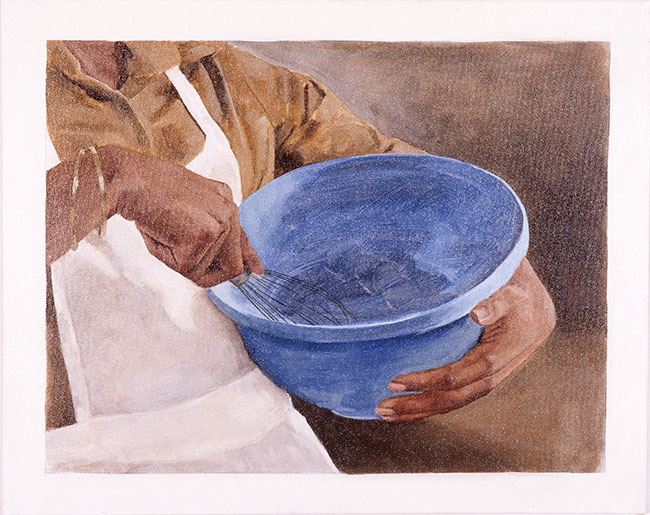
The AFA is pleased to share Dine (2021) by Braxton Garneau. This artwork is currently on display in the New Views exhibition at the AFA art house in Calgary, which has free admission.
About the artwork
Dine is part of a series of five works by Braxton Garneau that was included in the …bring a folding chair exhibition organized by the Art Gallery of Alberta in 2022 for the AFA’s Travelling Exhibitions (TREX) program. The exhibition was curated by Shane Golby. It was inspired by Black History Month and recognizes the significant contributions Black Canadians – particularly Black artists – make to Alberta.
This piece joined the AFA Art Collection when it was purchased as part of the Art Acquisition by Application program in 2024.
Since the mid-1800s, the Black community has had a long and rich history in Alberta. However, even in 1944, many restaurants in Edmonton discriminated against Black people and banned them from their restaurants.
The year 1944 is when Hatti Melton opened Hatti’s Harlem Chicken Inn in downtown Edmonton, serving up her own recipes of fried chicken, biscuits, hot tamales, steak, and more. The restaurant became a hub for the Black community and became known as the Black gathering spot for travellers, celebrities, and athletes.
To Hatti, the place was more than just a business. It was a way for her to provide jobs to women in her community who, because of racial discrimination, otherwise wouldn’t be able to find meaningful work. It was also a way for Hatti to provide food for people who couldn’t afford it.
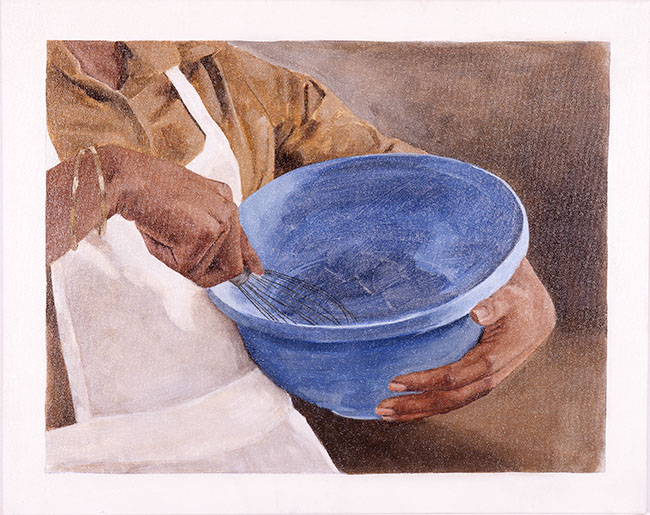
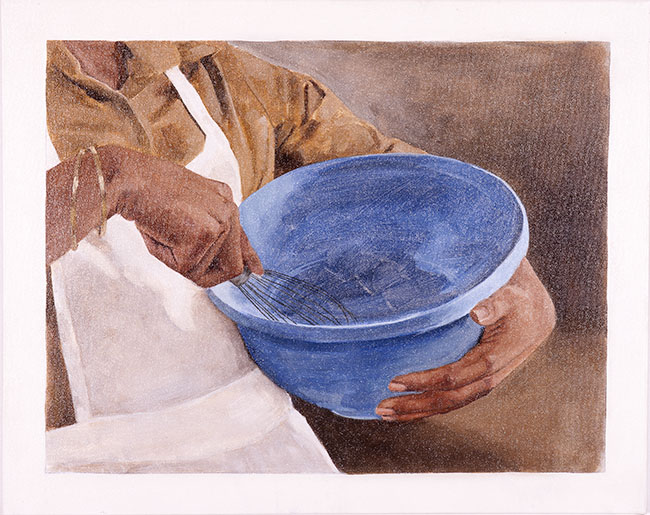
When it comes to the history and experience of Black Canadians, they have always been at the table, but the story hasn’t always been recognized, appreciated, or acknowledged. This artwork, which depicts Hatti Melton whipping up a dish, is about being heard and being seen and the more we tell these unique stories, the more they become everyone’s story.
About the artist
Braxton Garneau is a visual artist based in amiskwaciwâskahikan (Edmonton, Canada). He holds a BFA from the University of Alberta and has had solo exhibitions at the Art Gallery of Alberta, Edmonton (2024), GAVLAK, Los Angeles (2023) and Stride Gallery, Calgary (2021).
Creative practice
With a focus on painting, sculpture, printmaking and installation, Garneau’s practice is rooted in materiality, costuming and transformation. Working in-between cultures, he combines visual influences from classical and contemporary forms with material investigations to consider cultural, social and historical implications.
Garneau’s work investigates transformation through both natural cycles and the inherent human tendency for adornment, costuming and masquerade. Connecting materials, customs and clothing, he explores the ability of the natural world, and of the people in it, to adapt and transmute to whatever circumstances they may find themselves in.
Exhibitions and recognition
His work was featured in the retrospective exhibition Black Every Day at the Art Gallery of Alberta (2021), It's About Time: Dancing Black in Canada 1900 - 1970 and Now at Mitchell Art Gallery, Edmonton (2020), curated by Seika Boye, and New Direction, curated by AJ Girard and Artx at Château Cîroc, Miami, Florida (2021).
In 2024, his work Pitch Lake (Pietà) was acquired by the Museum of Contemporary Art San Diego through the Northern Trust Purchase Prize at EXPO Chicago, and he was awarded the Lieutenant Governor of Alberta Emerging Artist Award. He opened a solo exhibition at Efraín López in New York, NY in September 2024, and was accepted into the International Studio & Curatorial Program (ISCP), Brooklyn, NY in 2025.
More information
Learn more about the New Views exhibition at AFA art house.
Facebook title
Work of the Week: Celebrating Black History Month
Facebook description
In recognition of Black History Month, we feature Dine by Braxton Garneau.
Twitter title
Work of the Week: Celebrating Black History Month
Twitter description
In recognition of Black History Month, we feature Dine by Braxton Garneau.
News type
Art discipline
Social Media Preview
Collections Database Image
Image
Artist
Braxton Garneau
Title
Dine
Year
2021
Medium
oil on canvas
Collections Images Slideshow